



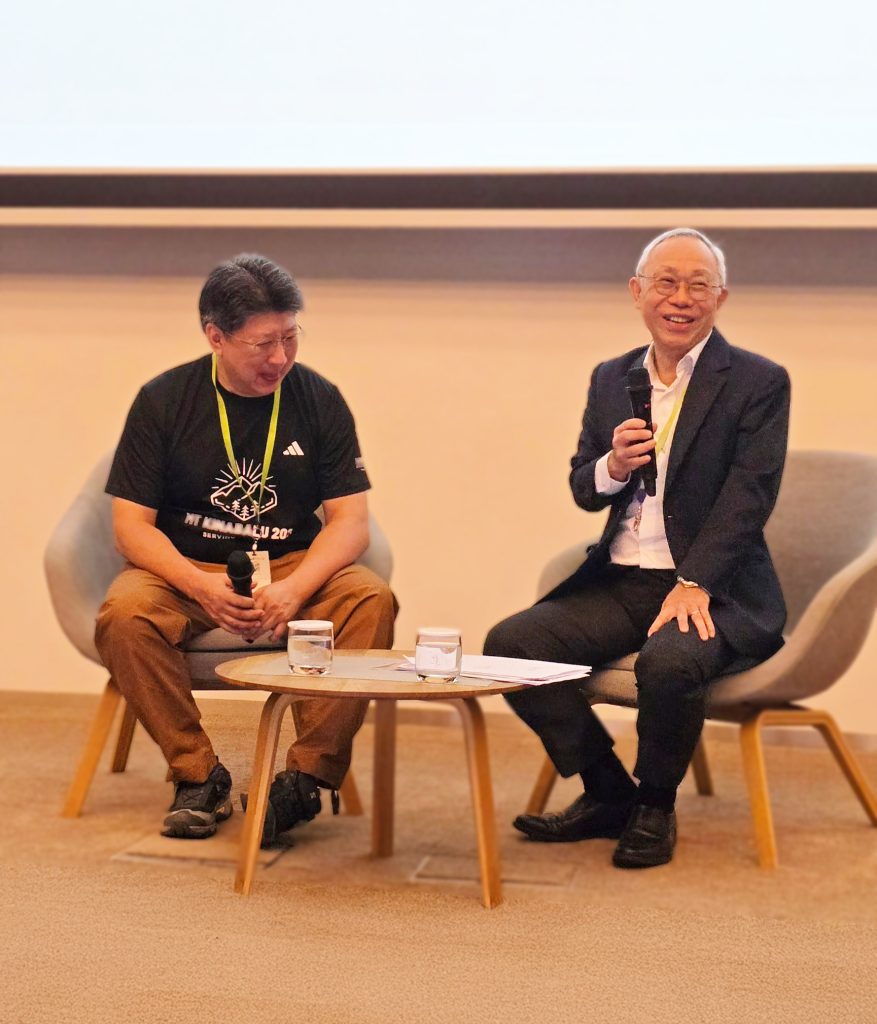
Commissioner of Charities, Mr Desmond Chin, joined our Board Director, Uantchern Loh at our annual seminar 24 July 2025.
The following is an excerpt of the discussion which has been edited for brevity.
Q: How do charities end up with mission drift?
A: This issue of mission drift is a very important one. There’s always a temptation when we are not focused on what our vision is, then the mission goes a little haywire. There’s a difference between vision and mission. A vision tells you where you want to go. A mission guides you on what to do in order to reach that destination. Now in organizations where that mission veers off tangent, a few things might have happened.
From what I have seen, this happens not just in the charity sector but also in corporate organizations. Sometimes when we have leadership changes at the top and the new chairman or executive director suddenly gets into his head that instead of doing thing one way, he decides to do them in a way that is not in line with his mission. Perhaps it’s his pet project or he’s trying to collaborate with somebody to do some projects that is not completely aligned with what you originally were set up to do.
When this happens, it is important that the rest of the board members jump in and have the courage to flag this veering off tangent to the chairman or whoever is causing this.
The second very common reason why we may go off tangent is when we meet a donor who wants to give the charity a lot of money but wants the organisation to do B when its mission is A. Don’t do that. You probably have to pay back the money at some point and when your mission does not align with what you are originally supposed to do, some things may fail. You will lose the confidence of your management team are your board members. Your stakeholders will start questioning why you are veering away from your original mission. You set yourself up for failure and that $10 million will not be as good as it originally seemed.
You may ask: who or what is the single source of truth for your mission? Is it the board chairman, or the beneficiaries or even the funders? There are a lot of charities and when an organisation applies to be a charity, I unfortunately am the one who has to decide whether this charity is allowed to be registered. The first thing that our officers look at in a charity registration application is whether the constitutional objectives of that charity falls within one of the nine charitable heads meaning poverty, education, welfare, social and welfare, health and so and so forth which you all are familiar with because you will fall under one or several of these charitable objectives. So, your charitable objectives tell you what you are supposed to do. Unfortunately, a lot of charity applications try to cover all the different charitable heads. I have seen charity applications for objectives from animal welfare to helping the elderly. This is very strange. In these cases, we have to ask the organisation what exactly they are focused on. The organisation has to clarify and sometimes we have to reject the application because these applications are not defined. So, I think your single source of truth really is a well-written constitution that clearly spells out what you are set up to do. Usually, the organisation wants to do one or two major things. In some organizations, they set out a vision statement. That vision statement is your North Star. It is different from your mission. Your mission guides you or tells you how to get to your vision. But your vision statement is the one that tells you this is where we are headed, this is where we ought to be. We are not there yet and therefore we are on that journey trying to get there. So, the two clear guide poles which will be helpful if you want to prevent mission drift are: one, your objectives for which you are set up to do and two, your vision statement.
Q: Where does purpose fit into this?
A: In setting up a vision, you will answer that question. I will use an example from the prison service because that is where I came from and where I was for 30 years. Sometime in 1999 or 2000, the commissioner then wanted to revisit the purpose of the prison. The prison service then was very big on security and operations. Rehabilitation was an idea, but the prison service was not organized for it to be properly executed. So the first thing that that the commissioner then did was to gather 900 out of the 2,400 staff, about 40% of the staff, for a retreat. We spent perhaps 2 days locked up in the venue until we trashed out a vision statement. I did not see my family for two days. In the end we came out with a very clear vision statement that expresses who we are, why we are doing this and what we want to achieve. Why am I telling you this story? Because a vision that encapsulates the purpose and the why and so on and so forth should not come from one person. Certainly, it should not come from your chairman alone, or your ED alone or just a person. The reason why you need to have a collective effort in building a vision is so that there is buy-in and ownership. When they look at the vision, your people and your staff will say we built this vision together. Therefore, in executing it, there will be more purpose to it and it is more compelling for them.
Q: How often should a board review your mission and vision statements?
A: The answer is actually very simple. I always advocate that whether you are in a corporate entity, or you are a charity, we should work out 3-year plans. Long ago, government agencies loved to work on 10-year plans. Then we realized that the cycle of change is very fast. So, the government agencies then moved from 10-year plans to five-year plans. After that, we realize that the cycle is even faster so now we have landed on three-year plans. So, every year, the team and I will look at our three-year plan that was set up last year to figure out whether any of those things that we had put in is still relevant or if it needs to be taken out or tweaked. If something is not relevant anymore, then you make a conscious decision to take it out and if something has changed, you better put in that something new. So, if I were you in a charity setting, if I were to do run a charity, this is probably what I would do with my team every year. I will try to set out a three-year plan. Rudimentary as it may be, it forces all of you including myself and my team to figure out what we see on the horizon, what resources we have, what capabilities we lack, where the gaps are that we need to fill and then you chart out your plans and every year you take it out and take a look at it and say what stays, what goes and what needs to be adjusted.
So, if you do that, the basic question you ask yourself is if my mission is still compelling or rather is my vision still compelling and is my mission the correct one. Then you decide whether you need to make course adjustments.
Q: How do you make mission lasting and not be equal to running events, fundraising, uh stakeholder engagement? How do you put some meaning to it?
A: Do not think that once a charity has determined its vision and its mission, they always have to be that that way. Some room must exist for changes to your mission or your vision. But it has to be quite deliberate, and it should not be for the reasons such as changes in key personnel, as I have mentioned earlier. And why do we change? One is perhaps the need to change with the times. For example, 20 years ago our population had not aged very much. But we know today that by 2030 one in four Singaporeans including myself will be at least 65 years and above right one in four which means that three individuals have to work to support one 65-year-old chap. Imagine if I am running an elder care service program and my original plan was to expand one center per year. Imagine if my organization is very well organized or I have the trust of the funders, private and government, then I am capable of expanding quicker to meet growing needs and even make some changes because I realize that among older people, a lot of them are having dementia or some form of disability. Then my care services should then be expanded to cater for some of these emerging needs that are changing, and which were not originally exactly the same as what my purpose and my mission was. So, where circumstances warrant a change or adjustment to your mission, and the reasons for it are good, then please do not become so fixated that you reject change.
The second thing then is if you are going to shift your mission slightly, then the common sensical thing to do is to ensure you have approval of your board, your team and all the people who are working in the organisation Otherwise you will confuse them completely. That buy-in is important otherwise you will end up in disagreement and my office may get a lot of complaints. This is the reality. I would urge you to really share those plans clearly and make sure you give people enough time to provide feedback. Sometimes taking your time is not slow, it is strategic, and it helps you to move forward.
Q: What are tips and thoughts on how to correct mission drift?
A strong chairman helps because he can steer the conversations to a more productive end.
The chief executive must also be clear in his strategic planning and brief the board well and provide time for them to give their views.
The GEC checklist is also important. If done properly, t is a tool to help you to bring board members and management together. If you need help, bring an independent party in for your strategic retreat to help facilitate the conversations.
Q: What are your plans for donor education, and for new board members preparing for their role?
A: The charity council that helps the COC’s office has put up this Govern Well series. If the charity boards attend the board training which covers many things from fundraising to transparency to governance issues and so on and so forth, if you can educate our boards well then the right mix of boards will be able to provide the correct direction for its management team. Then management can do your job properly, and your beneficiaries will gain.
I would urge that that you send your board members and your management team for what we call the essential board training or essential training for governance. It will be 80% sponsored or funded by the CCF fund. Do encourage your teams, your board or your management team to attend because it is heavily subsidized and run by very good people. If your board is well-run, your management team will be clear in its mission and then you will be able to do what you need to do without drifting off hand.
-End-